








My goal with color photography is to witness and capture scenes of uncommon beauty in nature with as much fidelity to what I saw as possible, and to present a visual record of these fleeting and rarely recorded events.
J.D. McGrew
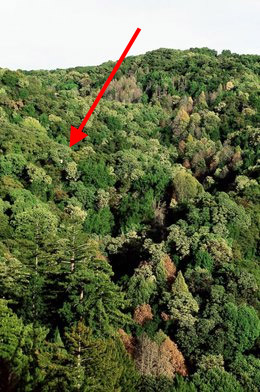
"My base was a cabin in Big Sur..."
The Photographer
My greatest pleasure is finding rare scenes of beauty in nature, recording them, and sharing them as I remember them. Of the images I make, those that appeal to me the most have a kind of abstract, painterly quality.
I first became interested in photography in my junior year in college. A friend who was a master printer at a Hollywood professional lab gave me an old rangefinder camera and started showing me how to process film and make prints. My senior college year received short shrift as I delved into black and white 35mm photography. Later, in Berkeley, California, I started Spontaneous Camera, photographing families at play in Golden Gate Park and other pastoral locations and producing custom family portfolios.
Later, working in communications, primarily in higher education, I used my background in photography and design to create magazines, graphic displays, slide presentations and video productions. After retiring from education, I moved to the California Central Coast and began pursuing in earnest my life-long fascination with the beauty of the natural world.
For seven years my base was a cabin in Big Sur that faces due west, clings to the side of a canyon and overlooks a variety of trees and the sea below. Redwood, Madrone and Coast Live Oak all form a green canopy that stretches across the ridges of the Santa Lucia Mountains and down its valleys to the Pacific. I spent much of my time hiking the Santa Lucia's and traveling the coast and beyond, finding and capturing beautiful images in order to relive them and share them.
The Photographs
Cameras, Film, Digital Files
The best camera cannot give someone "an eye" for composition and light. So I discuss equipment and film here not because I think that making a great picture is dependent on the camera being used, but because some visitors to this site will be curious, just as I have been, about how photographers make their images.
Many of the earlier color images posted at Luminous Lands are from 35mm "Velvia 50" transparencies taken on Canon cameras using Canon lenses. Other 35mm images are in black and white (Tri-X film or digital files converted to black and white) and present a broad range of subjects including landscapes, still life, and people. Some images were captured with a Mamiya RZ67 Pro II 6x7 (2 ¼ x 2 ¾) using Mamiya lenses, and a Fuji 6x9 with the 90mm fixed scalpel-sharp lens.
The 4x5 images were captured with an Arca Swiss Metric F.
I most frequently shoot with Canon digital cameras and Canon "L" lenses.
The Quality of Luminous Lands Prints
I spend as much time as necessary to personally prepare or "develop" each image for printing.
Photos captured on film are drum-scanned on a Heidleberg Tango 16 bit drum scanner to achieve the highest quality digital image that faithfully reproduces all of the beauty in original transparency or negative.
Photographs originally captured on a digital camera are prepared for printing at file sizes that ensure high resolution of the print.
Most prints are made using Chromira or Inkjet printers. Some smaller prints may be made on an Epson Inkjet printer. All prints are made on the finest archival papers available.
The combinations of the papers and inks I use are rated by Wilhelm Imaging Research at a minimum of 70 years to 200 years, ensuring that an image you purchase from Luminous Lands can be shared for a lifetime and more.
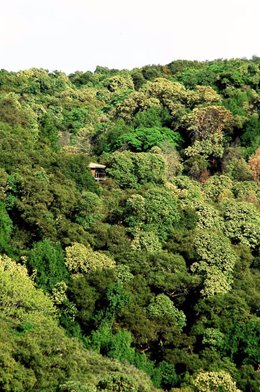
"...that faces due west, clings to the side of a canyon..."
Objective or Abstract?
Many of these images are clearly realistic and identifiable. You can see recognizable forms that indicate you are viewing mountains, ocean or trees, etc. Many of the images are abstract, showing a section of detail from a larger scene that emphasizes color and form in nature without presenting the visual clues that help the viewer identify the source of the image. And then we have images that somehow blend objective and abstract qualities and teeter on the edge of one or the other.
Many of these images are of one, two or three predominant colors, soft-edged as if they were made by brushstrokes — and that does not mean out-of-focus — but it is why I say some of the images look as if they have been painted or that they are painterly. They tend towards the abstract; the objects that you are looking at are perhaps less important than the overall impact of the color, texture, and interplay of light and dark.
I find that the objects in the photograph are not as important to me as the light itself. What captures my attention is the quality of the light, how it affects and is affected by the objects they fall upon and are reflected by, including the atmosphere — whether clear sky or storm clouds.
Some photographers might decry my penchant for soft-edge shots (see "Straight Photography?") below. I must tell them that in most cases I did no manipulation to get those images; they are as I saw them in nature as they were affected by heat waves and light. The camera was in focus and the images are on the film or they were on the sensor just that way. And if they look beautiful to me, then I am happy to be able to see them again and share them, and I find their painterly qualities remarkably pleasing and fortunate in the extreme.
Alfred Stieglitz, then Ansel Adams, Edward Weston, Imogen Cunningham and their f64 group members were successful in their efforts to secure photography as a respected art in its own right, largely by leading a successful attack on painterly or "pictorial" photography as it was called then. Because of their efforts and success, I and other photographers now have the luxury of creating photographs that are either realistic or impressionistic, or beautifully hovering somewhere between both.
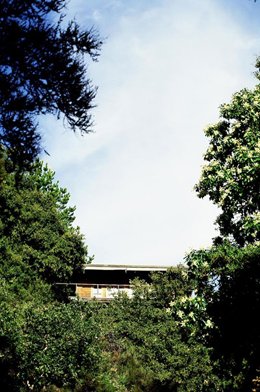
"...and overlooks the Sant Lucia Mountains and the Pacific, below."
"Organic" Photography
Organic: "Constituting an integral part of a whole; fundamental" (thefreedictionary.com);
"Simple, basic, close to nature" (American Heritage Dictionary);
Embellish: "to add fanciful or ornamental details;" (American Heritage Dictionary)
The digital revolution in photography and the tools it provides now produces different types of results for which standard descriptive terminology has not been established. Is a digitally processed photograph what the photographer saw? Is it organic — i.e., consisting only of the objects visible at the time the shutter was released and the colors present at that time? Or is it digital art — synthetic or embellished photography — with objects like the moon or clouds added or colors added or increased that were not present at the time the image was made? Further, if substantial changes were made in the visual contents of the image after exposure, including objects added and/or significant color embellishment, is that information accessible to the client?
I use the term "organic photography" to describe the way I usually work in color landscape photography. It means that normally most of my color images are processed to represent what I saw when I made the shot. First, I apply the word "Real" as in "Real Landscape Photography," to indicate that I do not use digital software to take an object from one photo and insert it into another. If you see the crescent moon in one of my photographs, it really was there when I exposed the image. Second, I am using "true-color" to indicate that I generally refrain from using the hue and saturation sliders available through digital technology (e.g., Photoshop and Lightroom) to boost color beyond my original perception and capture of the scene. I generally do not push the colors beyond their inherent values. In the event I choose to go beyond that general principle by enhancing the color a bit, I make notes to that effect and am happy to discuss them with the client. Suffice to say I don't think that all photographers ought to be doing this "organic"or "straight" photography. But I do think it is fair for clients to ask about the degree of enhancement in a photograph, and for the question to be answered.
I believe these images that have not been subjected to extreme color manipulation are generally preferable to "colorized" images. Why do I work this way? Because many people are aware of the rampant use of digital manipulation to modify images and want to know if they are viewing what the photographer saw or instead, what he or she created in the computer. I find photographs of beauty in nature more meaningful when I know that they reflect reality — something that actually was seen and recorded — rather than a scene that has been digitally manipulated beyond recognition, that no one ever actually viewed in nature.
Some of the color images on this website are so vibrant that people seeing them are sure that I increased saturation beyond what the film or camera sensor captured; that is just not the case. Spectacular light and color in nature are relatively rare and often last only a matter of seconds. Most people do not have the luxury of time or patience to gamble hours away waiting on nature's capricious moods, so I am not surprised that people find some of these images remarkable.
Of course, every single choice in photography, from lens, film, filter, exposure, etc., has an impact on the final image. For example, Velvia 50, which I used to capture some of these images, is known to provide somewhat vibrant colors in comparison to some other films. In some cases, when using Velvia 50, I have reduced vibrant color that I thought exceeded reality.
In addition to color, this site also presents digital and film negative black and white images. My love of photography began with black and white and continues to this day. Of course, we don't see in black and white, so this medium is already unnatural in a very fundamental way, as opposed to images recorded in color. So when working in black and white I feel quite free to work with the image — perhaps varying contrast — to create the most pleasing print. Still, I do not cut and paste different images together or use other more extreme forms of digital image manipulation.
"Straight" Photography
The phrase "straight" photography has been used to describe the work of photographers like Ansel Adams and Edward Weston, who sought to produce images that accurately reflected the appearance of the scene they saw in their ground glass, rather than resembling the soft-edged scenes painted by "pictorialists," who were considered romantic rather than realistic. Adams, Weston, and their Group f64 compatriots, following in the footsteps of Alfred Stieglitz, sought to differentiate photography from painting. They rejected the practice of many early photographers who sought legitimacy by making photographs that appeared similar to the output of impressionists who worked with paint.
None of this is to say that there is really such a thing as "pure" or "straight" photography; that somehow using the traditional technology of lens, film, and camera, is a more noble activity than using a digital camera and Photoshop. I am not pretending that. Every choice of lens, filter, film, aperture, shutter speed, paper, etc., affects the final image. Everything we do in photography is dependent on technology, whether that technology is traditional film-based or new digital processes, whether we are using a pinhole box or an $40,000 digital camera. I view digital technology not as antagonistic to traditional film photography, but as a recent, if extreme, extension of a long history of slowly evolving photographic technology.
The issue is not film-versus-digital. It is this: do we use old and new technology to render as faithfully as possible what we saw, or do we choose to go beyond what we see, using that as a basis for extra-creative image manipulation? This is where Photoshop or other software comes in, for people who want to use it to change colors, combine elements from different pictures, or otherwise substantially modify image content. There are two questions here. The first, What is the goal of the photographer? The second, Is the photographer telling us the goal and processes used to achieve it?
This digital painting does not interest me; perhaps because it seems too easy to boost the impact of either a good image or a mediocre one by running it through the computer. Not that that is not creative, and not that it cannot produce beautiful images; it can and does. But to me, doing that to produce virtual images as a common practice seems much easier than finding and capturing what is actual, i.e., natural light and natural beauty. And if digital painting is easy to do, by comparison, how much relative value does the result have?
On the other hand, when a photographer comes across a scene of uncommon and sublime beauty in nature – sometimes subtle, sometimes spectacular – and you as the viewer know that beauty actually existed, that someone was there to witness it, capture it, and bring it to you as accurately as possible, you know that you are viewing an event that rarely occurs. That event is even less often recorded, and is therefore of great value. That kind of image is worthy of the viewer's attention and interest because it actually existed, often for mere seconds only; that is why some images are so striking and revelatory and sought after. Most people lack the time it takes to be exactly where the beauty — thanks to changing light — will form, last but a moment or two, then fade. Like a fleeting glimpse of the heretofore-extinct ivory-billed woodpecker, a scene of beauty in nature is real but ephemeral, and has not been manufactured on a digital assembly line.
Even though I accept the validity of using digital tools to render an image faithfully, I admit to being prejudiced in favor of what one puts into the camera over what one adds or modifies later in Photoshop. For example, I once shot the sun sinking below the Pacific and creating a unique band of emerald green under a band of orange, running along the entire horizon. When my slides came back, no green was visible — just orange. In accordance with my basic premise of using technology to recreate what I saw, I would have been justified in putting the green back into the image as I originally saw it, but even though that would meet my standards, it just seemed too extreme.
The Care of Photographic Prints
The charts of Wilhelm Imaging Research show the relative importance of different methods of display, arrived at by techniques that project forward the impact of different variables over time. For example, when printing on an Epson Pro 3800 using Epson Ultra Chrome K3 inks on Epson Ultra Smooth Fine Art Paper, and displaying a color print framed under glass, permanence is rated beyond 108 years. If you change the equation by replacing standard glass with UV filtered glass the predicted permanence extends to more than 175 years. On the other hand, if you display that print unframed under bare-bulb light, expected permanence decreases to a minimum of 57 years.
When printing a black and white image on Epson Ultra Smooth Fine Art Paper, again using Epson Ultra Chrome K3 inks, using the Epson Advanced Black and White Processor, when framed and displayed under glass, a quality image is projected to last beyond 205 years. Displayed under UV glass, expected longevity in a quality state exceeds 300 years; and without glass, under bare-bulb, a quality image exceeds 138 years.
For specific information regarding the length of time prints resist fading and deterioration link to Wilhelm Imaging Research at: http://www.wilhelm-research.com/
Storing Prints
Store photographs in a cool, dry location that is well-ventilated.
Avoid high temperatures and high humidity as these factors increase deterioration and the growth of mold and mildew.
Attics, basements, and some external walls are the wrong locations for storing all types of photographic materials including aging family albums in boxes. Such places can have extremes in temperature, humidity, and condensation.
Never hang or store prints near heat sources, including heating vents, fireplaces, and especially not in an area that receives direct sunlight coming through windows.
The ideal storage conditions for most photographs: a temperature of 68 F and relative humidity in the range of 30 - 40%. Negatives and today's color photographs can be stored in cooler environments of 30 - 40 F and 30 - 40% relative humidity.
Store prints on shelving above the floor in a way that allows the circulation of air.
Never stack "naked" prints together; separate them with acid free paper.
Displaying Prints
Avoid framing prints with the glass against the print; an acid free mat can keep the glass above the print rather than resting on it.
When handling prints wear cotton gloves; body oils can damage prints.
Always handle unmounted prints with two hands to avoid crimping the paper or edges.
Light fades photographic prints and paintings. Never hang or store prints where they can receive direct sunlight, and never place them closer than several feet from a light bulb as bright as 100 or 150 watts or more.
Always use acid-free mattes.
Framing with normal glass allows completely clear viewing of the image but does not cut glare. Anti-reflective glass reduces glare considerably but can also very subtly reduce the clarity or brightness of the image it protects.
Avoid light containing ultra-violet rays, such as fluorescent lighting, or use plexiglass in your framing, which blocks ultra-violet.
Halogen lamps are generally recommended for showing your photographs to their best advantage, meaning halogen affects the visual characteristics of the image least, compared to other artificial lighting sources. However, older halogen bulbs created quite a lot of heat, and they have caused burns to people and fires when not sensibly used. For additional in-depth information on care of photographic materials: http://aic.stanford.edu/library/online/brochures/photos.html. Also, Wilhelm Imaging Research publishes a book on the care of photographs: http://www.wilhelm-research.com/.
Please also see: